Movement Meets Breath: A Framework for Versatile Bodies
Feb 04, 2026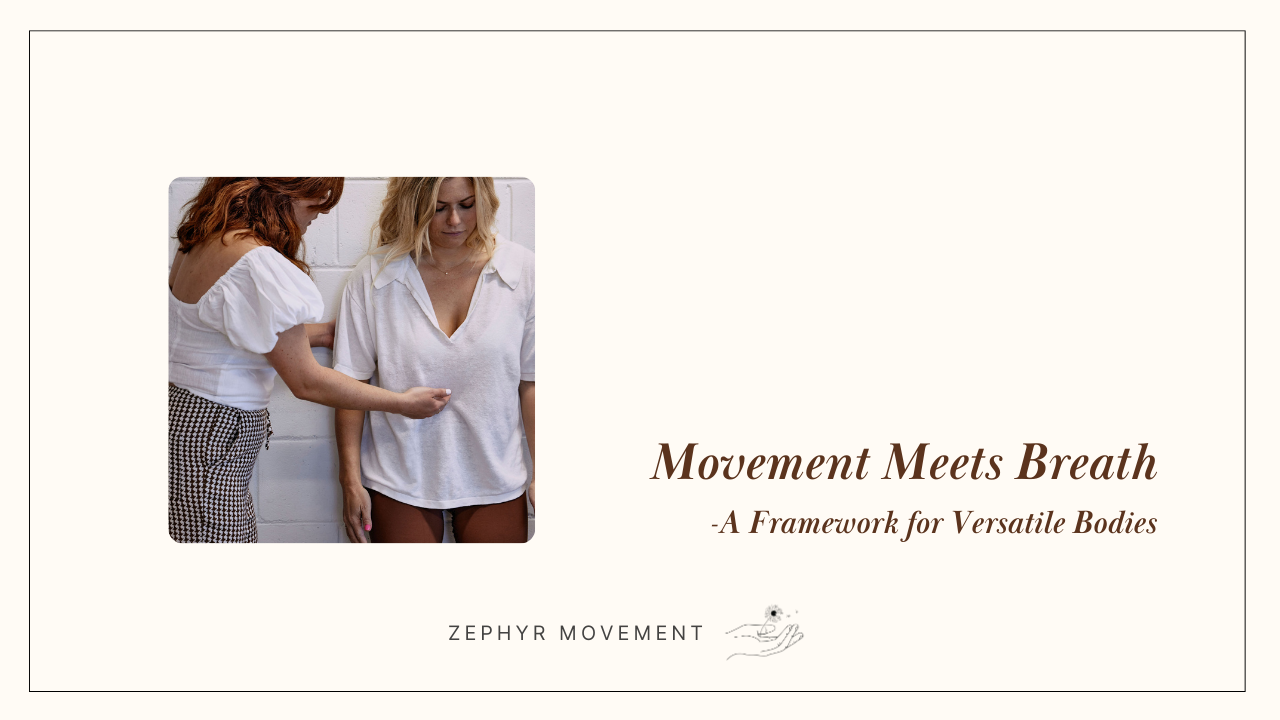
A Breathing-Based Approach to Traditional Physio
Rather than starting with exercises, I’m often looking at how someone moves and how they breathe, and whether those two things reveal patterns about vulnerabilities their body may have. I use this as a framework to train for an adaptable body. There is no right or wrong, better or worse, it simply may benefit someone to work on their less dominant strategy to optimise versatility and durability.
Movement bias: flexion vs extension
This looks at someone's dominant tendency in how movement is achieved through transitions. There’s no right or wrong.
Supine to sidelying:
- Do they initiate with abdominals?
- Or push with legs or back?
Prone to kneeling:
- Do they pull up from their legs?
- Or push with their arms?
Often this gives more information about long term patterns. It may be helpful when traditional approaches are plateauing.
Baseline breathing patterns
Before adding load or complexity, are they breathing and how. This can give information pressure control with movement and stability. It can impact how the load is shared throughout the body.
- Is there breath holding?
- Is breathing chest-dominant?
- Mid thoracic vs upper?
- Superior-inferior? (S-I)
- Anterior-posterior? (A-P)
- Or is it diaphragmatic?
- Posterior–lateral? (P-L)
- Anterior–lateral? (A-L)
This becomes the reference point to find different ways to distribute pressure throughout the body when under load.
Common Flexion Patterns:
Pain: Neck/shoulder/shoulder blades
Default Programming: Supine→sidely using abs, if breathing often P-L diaphragmatic, backward translation of rib cage. Creates forward head posture, blocks shoulder depression and shoulder blade retraction.
Challenge for versatility: In prone encourage a mid thoracic A-P breath and encourage neck extension on the exhale initiating at the thoracic spine/shoulder blades.
Key Cue - chest heavy into the ground to start to lift head.
Common Extension Patterns:
Pain: Low back/hip/knee
Programming: Supine→sidely push with legs, if breathing often A-L diaphragmatic, forward translation of rib cage. Creates flared ribcage, elongates abdominal lever arm, reduced pelvic tilt range, adduction + internal rotation.
Challenge for versatility: In crookly encourage a posterior lateral breath with arms by your side, elbow pits upward + posterior pelvic tilt. Encourage the exhale to soften into imprint spine feel gentle lift of tailbone before larger movement.
Key Cue: Fill back of ribs with air. Allow the imprint spine don’t force.
Broader considerations (sometimes missed)
- How does hypermobility alter these patterns?
- How does mind–body connection (or lack of it) impact motor control?
- How could each pattern create the same symptom but have a different mechanism and treatment?
- How do factors like abdominal obesity, pregnancy, or post-partum changes affect trunk mechanics?
- What role does the pelvic floor and vocalisation play in pressure regulation?
- Is CO₂ tolerance relevant (e.g. sports performance, Bohr effect)?
- Is there a place for exploring maximal volume breathing to improve rib cage compliance (think diving physiology)?
Join the Wellbeing Check-in
Thurs 30min 'welfare check'. If your career doesn't fit neatly into a job title, see if our network matches your values more than your job description.
Just because your peers are less clear doesn't mean you don't deserve the check-in.
- May 28th 12pm
- Jun 4th 12pm
- Jun 18th 12pm
- Jun 25th 12pm
We mindfully share emails with you and protect your details.